Digital microfluidics is an alternative paradigm for lab-on-a-chip systems based upon micromanipulation of discrete droplets. Microfluidic processing is performed on unit-sized packets of fluid which are transported, stored, mixed, reacted, or analyzed in a discrete manner using a standard set of basic instructions. In analogy to digital microelectronics, these basic instructions can be combined and reused within heirarchical design structures so that complex procedures (e.g. chemical synthesis or biological assays) can be built up step-by-step. And in contrast to continuous-flow microfluidics, digital microfluidics works much the same way as traditional bench-top protocols, only with much smaller volumes and much higher automation. Thus a wide range of established chemistries and protocols can be seamlessly transferred to a nanoliter droplet format.


Research in Dr. Richard Fair's laboratory at Duke University has focused on the use of electrowetting arrays to demonstrate the digital microfluidic concept. Electrowetting is essentially the phenomenon whereby an electric field can modify the wetting behavior of a droplet in contact with an insulated electrode. If an electric field is applied non-uniformly then a surface energy gradient is created which can be used to manipulate a droplet sandwiched between two plates. Electrowetting arrays allow large numbers of droplets to be independently manipulated under direct electrical control without the use of pumps, valves or even fixed channels.


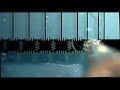
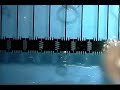
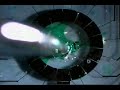
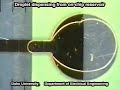
Click on the thumbnail to launch the video. All videos are in mpeg-1 format (*.mpg), 640x480 resolution, and play back in real-time. A fast computer is recommended for accurate playback.

The following videos demonstrate electrowetting-based manipulation droplets. Except where otherwise noted the droplets are approximately 700 nl in volume (about 1.5 mm diameter) and are surrounded by silicone oil.

The electrowetting effect (in air).
(1,132 kb)

Side-view of droplet transport (in air). (930 kb)
Top view of programmable flow on a 2-D electrode array. (1,823 kb) Top view of a 6 nl droplet (~0.3 mm diameter) transferred at over 200 Hz on an electrode array. (1,944 kb)
Top view of flow on a ring structure. (2,697 kb)    

The following videos demonstrate formation and dispensing of droplets. Except where otherwise noted the droplets are approximately 700 nl in volume (about 1.5 mm diameter) and are surrounded by silicone oil.

Top view of slow droplet dispensing from an external source.
(2,396 kb)
Top view of fast droplet dispensing from an external source.
(1,847 kb)
Top view of multiplexed droplet formation from an external source. (3,581 kb) Top view of droplet formation through electrowetting. (3,852 kb)
Top view of on-chip dispensing of droplets through electrowetting. (3,581 kb)    

Fluorescent and non-fluorescent droplets are merged and shuttled across several electrodes. The volume of each droplet is 1.32 uL (about 1.5 mm diameter with 600 um height), and are surrounded by silicone oil.

Top view of 2-electrode mixing at 1 Hz switching speeds (slow mixing).
(2,653 kb)
Top and side views of 4-electrode mixing at 16 Hz switching speeds (rapid mixing). (267 kb)

KCl droplet is split and merged across several electrodes. The volume of each droplet is about 0.5uL. (3,474 kb)
   

The following videos demonstrate biological assays using the digital microfluidic platform. The use of silicone oil allows for transport of proteins with minimal contamination.

Top view of a colorimetric glucose assay with 1 uL sample and reagent droplets. (2,609 kb)
Top view of a 1.4 uL whole human blood droplet oscillating at 16 Hz. (4,144 kb)

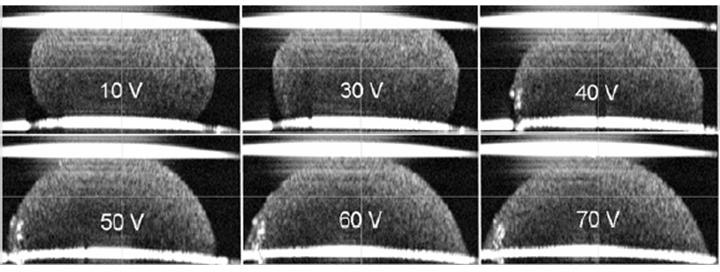
Optical Coherence Tomography (OCT) was utilized to observe the static contact angle, dynamic contact angles and flow patterns. All the OCT experiments were performed in 1cSt silicone oil.

Tomographical view through the center of a 0.5uL skim milk droplet at slowed down 8X to observe the dynamic contact angles. (2,815 kb)
Tomographical view through the center of a 0.5uL KCl droplet with 50nL of polybeads on 1mm electrodes and 520 um gap to study the reversibility in the flow patterns. (6,273 kb)
Tomographical view through the center of a 0.5uL KCl droplet with 50nL of polybeads to evaluate the end point of mixing by observing the uniformity of the distribution of the beads (7,463 kb) Tomographical view through the center of a 0.4uL polybead
and KCl
droplet to observe the contact angle saturation.


Current research group members include:


  1. J. H. Song, R. Evans, Y.-Y. Lin, B.-N. Hsu, R. B. Fair "A Scaling Model for Electrowetting-on-Dielectric Microfluidic Actuators," Microfluidics and Nanofluidics, vol. 7, pp. 75-89, 2009. PDF

  2. L. Luan, R. D. Evans, N. M. Jokerst, and R. B. Fair, "Integrated Optical Sensor in a Digital Microfluidic Platform," Sensors Journal, IEEE, vol. 8, pp. 628-635, 2008. PDF

  3. R. B. Fair, A. Khlystov, T. D. Tailor, V. Ivanov, R. D. Evans, P. B. Griffin, S. Vijay, V. K. Pamula, M. G. Pollack, and J. Zhou, "Chemical and biological applications of digital-microfluidic devices," IEEE Design & Test of Computers, vol. 24, pp. 10-24, 2007. PDF

  4. R. B. Fair, "Digital microfluidics: Is a true lab-on-a-chip possible?," Microfluidics and Nanofluidics, vol. 3, pp. 245-281, 2007. PDF

  5. R. Evans, L. Lin, N. M. Jokerst, and R. B. Fair, "Optical detection heterogeneously integrated with a coplanar digital microfluidic lab-on-a-chip platform," IEEE Sensors 2007 Conference. pp. 423-426. PDF

  6. S. Fei, K. Chakrabarty, and R. B. Fair, "Microfluidics-based biochips: technology issues, implementation platforms, and design-automation challenges," IEEE Transactions on Computer-Aided Design of Integrated Circuits and Systems, vol. 25, pp. 211-23, 2006. PDF


WARNING
: This directory contains pdf files of articles that may be covered by copyright. You may browse the articles at your convenience, in the same spirit as you may read a journal or a proceedings article in a public library. Retrieving, copying, or distributing these files may violate copyright protection laws.


Bang-Ning Hsu (bh45 AT duke.edu)
Department of Electrical and Computer Engineering
Box 90291
Durham, NC 27708
919-660-5578 (office)


Last updated: Sep 10, 2009